

Motivational credibility
A party can break a commitment, but has a reason not to.
The commitment holds for as long as the incentives to keep it do.
$4.2B frozen post-settlement with selective enforcement

PriFi, or private finance, is a technical design philosophy: financial primitives deployed on privacy-preserving, peer-to-peer infrastructure, on hardware you control.
Strengthening commitments to reduce transaction costs by limiting what an attacker can learn about a transaction and what they can manipulate.
Purpose-built for privacy and security, not patches "bolted on" later.

Settlement is just one of seven links in the chain. Blockchain provides unprecedented settlement security. But transactions depend on infrastructure beyond settlement. Every exposed link creates another opportunity for privacy leaks or manipulation. Increased risk means increased transaction costs.
PriFi protects participants from two directions: limiting what an attacker can learn and what they can influence. Leaks cost billions annually. Even small efficiency increases add up: a 0.1% drop in transaction costs can quadruple a nation's wealth.
What is exposed
Counterparties, intent.
Where exposure occurs
Browsers, order books, RFQ platforms, direct messages, block explorers, wallets leaking IPs, globally linkable identity graphs via fingerprinting.
Threat model
Onchain analysis maps wallets and flows before a deal exists.
Costs in crypto
$100M+
in losses from physical coercion attacks (Jan-Apr 2026)
Costs outside crypto
£42M
added to the acquisition cost by a single M&A leak in the UK
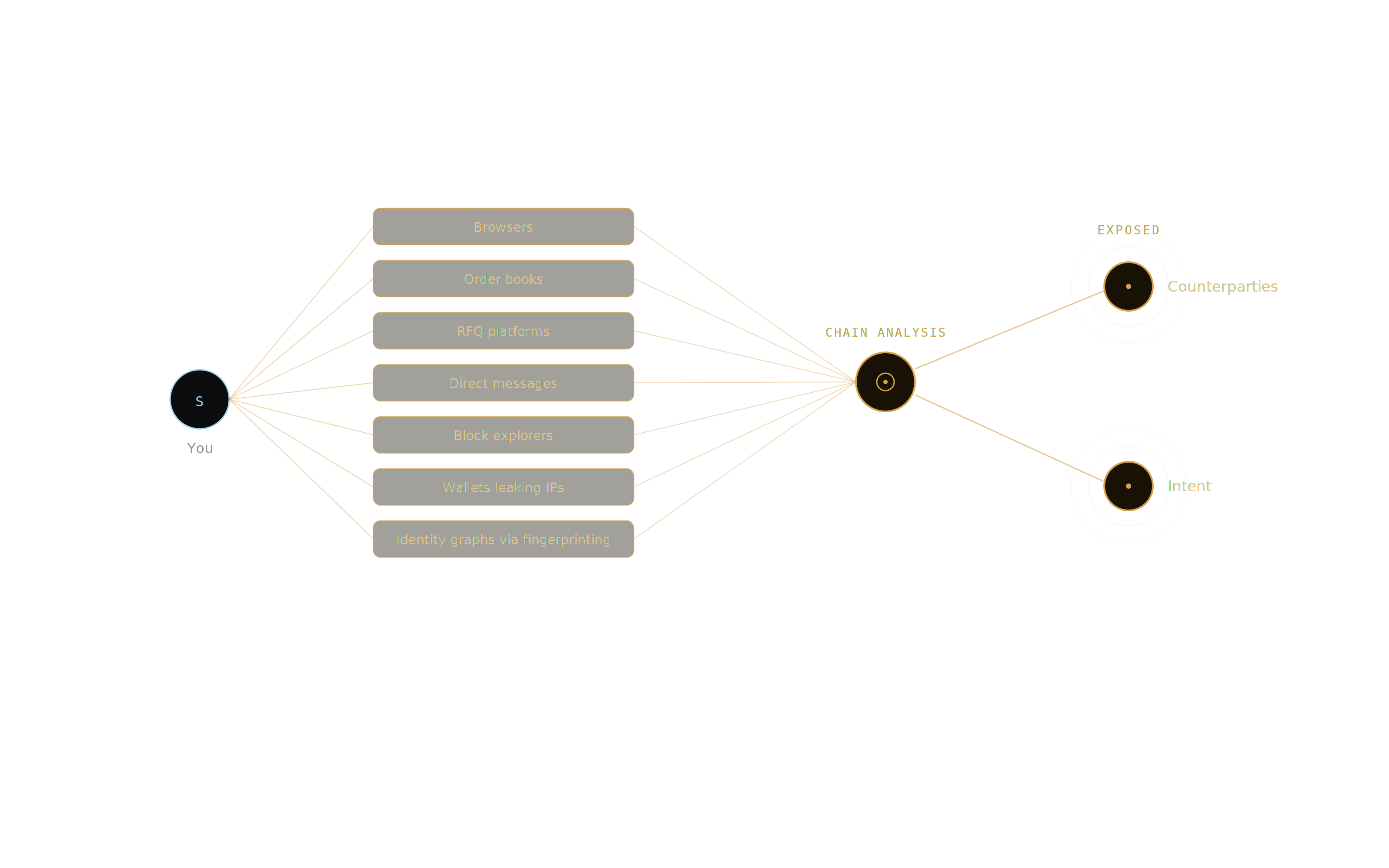
Each exposed link is an opportunity for exploitation. Secure one link and the attacker moves to the next. PriFi aims to protect the whole transaction supply chain.
The person or institution you're transacting with
Counterparties need information to make a deal possible, creating opportunities for misrepresentation, concealment, default, or other opportunism.
Able to exploit information made available by necessity, but bound by the deal's terms.
Everyone outside of the deal
Thieves and extortionists can target your holdings and what you can pay. Frontrunners and competitors can exploit your positions and intentions.
Outsiders are not party to the transaction. They signed nothing and cannot be bound by its terms, only denied exploitable information.
The two hazard classes require different defences.
Security binds, making defection difficult or costly.
Privacy starves, denying information needed to identify, target, or exploit a transaction.

| Security – constrains action | Privacy – denies information | |
|---|---|---|
| Counterparty | WorksInside the transaction and can be made subject to its rules and commitments. Security reduces their ability or incentive to misrepresent, default, or defect. | FailsA transaction requires some information to pass between counterparties. You can minimise what is disclosed, but you cannot remove the counterparty's access to the deal entirely. |
| Outsider | FailsEntered no agreement with you. There may be no contract, collateral, or protocol commitment capable of constraining what they do with information they obtain. | WorksAn outsider must first find something worth exploiting. Concealing counterparties, holdings, positions, and intentions removes the information needed to identify and attack a target. |
Transactions depend on promises about future behaviour. Promises that are dependable when breaking them becomes attractive are known as credible commitments. The stronger those commitments, the less participants need to spend verifying, monitoring, insuring against, or policing one another. The credibility of commitments can fall into two categories: motivational and imperative.
A party can break a commitment, but has a reason not to.
The commitment holds for as long as the incentives to keep it do.
$4.2B frozen post-settlement with selective enforcement

The discretion to defect is removed structurally.
The system makes violating the commitment prohibitively costly.
Blockchains introduced imperative credibility for transaction settlement by making rules self-enforcing.
When participants have structural assurances, rather than trust alone, risk mitigation costs fall. Lower transaction costs enable new market activity.
A complete, unified stack providing unprecedented imperative credibility at every link.
| Component | What it does | Links it covers |
|---|---|---|
| Basecamp | A self-contained desktop application that bundles everything you need to interact with the Logos stack. A UI running locally on user-controlled hardware. | Protects discovery and diligence |
| Logos Messaging | Anonymous communication and coordination. Stops intentions leaking before terms exist. | Protects discovery, diligence, and negotiation |
| Logos Storage | Decentralised content-addressed storage commits a content hash to the exact file or interface being retrieved: alter the content, and the hash changes. Instead of trusting a server, the integrity of what you load can be verified independently. | Protects contracting |
| Logos Blockchain (Blend) | Consensus-aware private propagation obscures where transactions and block proposals originate, disrupting ordering observation and exploitation. | Protects ordering |
| Logos Blockchain (Cryptarchia) | Private PoS keeps those securing settlement from becoming targets for bribery, coercion, or censorship. | Protects settlement |
| Logos Blockchain (Zones) | Programmable privacy makes disclosure selective. Participants can prove what is needed for compliance or dispute resolution without exposing entire transaction histories. | Protects enforcement |

Security and privacy have historically been expensive institutional services available through trusted intermediaries and favourable jurisdictions. PriFi extends access to anyone with an online device.
Logos infrastructure elevates institutional commitments from strong motivational to structurally imperative to provide even greater protections than those that were previously reserved only for the ultra wealthy.
The full argument — commitment capacity, the two hazard classes, and where the writ stops.
Why PriFi needs more than a private blockchain
Making commitments credible through structural design choices
Two hazard classes threaten transactions: those inside the deal and (potentially) everyone else