EmPoWering: Joining Logos Blockchain Without an Intermediary
Earn your participation in the Logos network without a traceable on-ramp.

Taking part in a blockchain usually begins with acquiring its tokens through an exchange, a bridge, or a faucet, and each of those routes can identify you before any privacy protection applies - EmPoWering gives anyone a way to obtain testnet tokens on Logos Blockchain using computational work alone.
Every blockchain asks something of a newcomer before it lets them take part. Posting a transaction costs a fee, and so does sending a message through a privacy layer, so a participant who arrives with nothing cannot use the network at all.
Most networks solve this with an intermediary. A testnet usually relies on a faucet run by the project, while a live network relies on exchanges and bridges, which is understandable enough, since they are the simplest way to put tokens into someone's hands.
However, every one of those intermediaries decides whether you may take part, and every one of them keeps a record of who you are and when you arrived. On a network designed to protect its participants, that record is created before any protection can set in.
EmPoWering, introduced in Testnet v0.3, is the proof-of-work mechanism that removes the intermediary from Logos Blockchain. It lets anyone obtain testnet tokens from the network, and send messages through the Blend Network, by performing computational work on their own machine.
Not only does this approach enhance privacy for new participants – it also allows applications to remove friction and deliver a better user experience by onboarding users to token-linked apps without requiring them to transfer an initial amount of tokens.
In this article, we will explore how EmPoWering works and what it means for privacy and sovereignty.
Private entry without third parties
Every conventional route into a network requires a transfer that leaves a trace. An exchange typically requires identity checks and records a payment, a bridge links your new address to an existing one on another chain along with its full history, and even a faucet sees your IP address and often asks for an account or a social media handle.
Whichever route you take, your first address on the network is tied to something that identifies you, and everything you do from that address afterwards inherits the link.
EmPoWering solves this by allowing you to enter the network in a privacy preserving manner by conducting computations on your own hardware instead of relying on a traceable intermediary.
You receive tokens from the network through this exercise, which can be transacted on the blockchain or used to participate in the Blend Network, which is designed to prevent block proposers from being linked to their stake as part of the network’s Private Proof-of-Stake consensus.
EmPoWering removes the link to a centralised on-ramp or platform that can connect your identifying information to your new address on Logos. Instead, if you wish, you can simply receive enough tokens through proof-of-work to start transacting on the blockchain, without needing to transfer in from another blockchain or via an on-ramp.
No on-ramp needed to start using Logos
As EmPoWering is further integrated into the ecosystem, the mechanism could also allow applications to offer a more intuitive user experience than traditional blockchain-based applications.
For example, when a new user interacts with an application that relies on RLN, they will need a number of tokens to interact with this system. Instead of transferring tokens from another chain or bridge into their wallet to begin, they can start participating directly by relying on EmPoWering to gain those first tokens.
App developers could build on this mechanism to allow users to use EmPoWering as part of their setup process, removing the friction often associated with blockchain-related applications. Through integrated EmPoWering, users could easily install and start using private and peer-to-peer apps built on Logos without even needing to worry about moving tokens onto the chain.
In this way, Logos uses Proof-of-Work as an entry point for private and accessible participation, while it relies on its novel Private Proof-of-Stake mechanism for secure consensus.
EmPoWering is not designed to outperform Proof-of-Stake for validator incentives – it is built solely for improving private participation; therefore the two mechanisms complement each other and do not compete.
How EmPoWering works
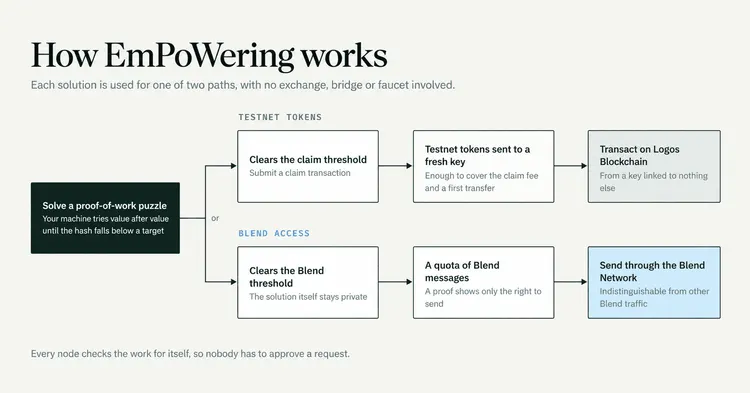
EmPoWering asks a participant to solve a puzzle. Their machine tries value after value until it finds one whose hash falls below a target, which takes time and electricity.
Checking a solution is valid just requires a single hash, so every node can easily verify the work has been completed. Each puzzle is also tied to recent network state, so solutions cannot be prepared in advance or stored up for later.
In the current version of the Logos Testnet, a proof-of-work solution can be used for either Blend access or to gain testnet tokens, and each use has its own threshold.
| Use | What a solution provides | Difficulty follows | Adjusts | Recorded on chain |
|---|---|---|---|---|
| Blend access | A quota of messages through the Blend Network | Transactions per block | Once per epoch | Nothing |
| Testnet tokens | A fixed amount of testnet tokens | Claims per block | After every block | A claim transaction |
For access to the Blend Network, the participant searches for a private value that clears the Blend threshold. That value stays secret, and the proof attached to their messages shows only that they are entitled to send them, so a message backed by computational work looks the same as one from a node that helps run the network.
The Blend threshold is set with modest hardware in mind. At the network's reference level of activity, a solution takes under a minute on average using a single core of a Raspberry Pi 5.
For testnet tokens, the participant tries fresh keys until one clears the claim threshold, then submits a claim transaction. Once the claim is accepted, a fixed amount of testnet tokens goes to that key.
The amount is set to cover the fee for the claim and for a first transfer, so someone arriving with an empty wallet can make the claim without already holding testnet tokens to pay for it.
Read more about EmPoWering in the Logos LIPs.
How the thresholds adjust
The claim threshold follows demand for testnet tokens. After every block it adjusts towards around ten accepted claims per block, so when more people are solving puzzles, each claim takes more work while the number of claims stays steady.
The Blend threshold follows activity across the network. Once per epoch it looks at how many transactions blocks have been carrying, tightening when the network is busy and loosening when it is quiet, with each change capped so it cannot swing sharply from one epoch to the next.
When the network is quiet and there is less ordinary traffic for messages to hide among, the lower threshold lets more participants into the Blend Network, and the traffic they add makes every message harder to single out.
Keeping the two thresholds separate means each can be adjusted independently, with demand for testnet tokens determining the cost of a claim and overall network activity setting the cost of Blend access.
Privacy and sovereignty from the start
EmPoWering removes the moment of exposure that usually comes with joining a network. There is no exchange account, no bridge transfer linking a new address to an old one, and no faucet request tied to an IP address.
A participant's first testnet tokens arrive at a key connected to nothing else. Additionally, they are able to contribute to the Blend Network without a traceable log or identifying approval, instead simply solving a puzzle to begin sending data and cover traffic.
Verification follows the same principle. Every node checks the work independently, so nobody needs the project, a faucet operator, or any other party to vouch for them.
EmPoWering is new to the testnet, and it is subject to continued development. The thresholds and the amount of testnet tokens available per claim are still being refined, and further adjustments are likely as the testnet runs.
EmPoWering addresses the exposure involved in getting started. Protecting transactions once a participant is inside the network depends on other parts of the stack designed along the principles of private finance.
It is important to note that testnet tokens exist for testing the network, and the testnet may be reset as development continues.
Read more about the launch of Testnet v0.3
Get started with Logos
Testnet v0.3 is live now. If you would like to get involved, download Basecamp and run a node on your machine.
If you want to contribute capacity and play a role in the network, check out the node operator guide.
Building infrastructure for everyone is an open, collaborative effort.
If you have ideas, objections, or want to understand more about what Logos is building, join the conversation on the Logos forum.